Menu


Labels

Search This Blog

Showing posts with label Nuts. Show all posts

Tuesday, 1 October 2013

Pistachio

What is Pistachio?

Wonderfully delicious pistachio nuts have been revered as the symbol of wellness and robust health since ancient times. The nuts are enriched with many health-benefiting nutrients that are essential for optimum health.
Pistachio nuts are dry fruits of species of trees belonging in the Anacardiaceae family, of the genus:Pistacia. The plant is a medium sized broad, bushy, dioecious, deciduous tree, believed to be originating in the mountain ranges of West-Asian region. Several cultivars exist; however, the most popular variety grown for the commercial purpose is the kerman.
The fruit, in fact, is a drupe (a fruit with a large, central located single seed), and the seed kernel is actually the edible portion. Each season, the tree bears heavy clusters of fruits, which appear somewhat like that of a grape bunch. Exteriorly, the mature fruit features off white colored, hard, shell with splits apart exposing yellow-light green colored oblong kernel, which measures about 1 inch in length and 1/2 inch in diameter.


Thursday, 6 December 2012

Walnuts

What is Walnut?

The large wrinkled edible seed of a deciduous tree, consisting of two halves contained within a hard shell that is enclosed in a green fruit The tall tree that produces this nut, with compound leaves and valuable ornamental timber that is used chiefly in cabinetmaking and gunstocks. As walnuts age on the tree the outer sheel dries and pulls away, leaving the shell and seed behind. Technically, a walnut is a drupe, not a nut, since it takes the form of a fruit enclosed by a fleshy outer layer which parts to reveal a thin shell with a seed inside. The walnut is not only good for cooking - they are healthy nuts that can also help your heart. However walnuts can pose risks to people with nuts allergies, so use them with caution in cooking. 


Sunday, 11 November 2012

Almonds

What is Almonds?

Although many of us would consider almonds to be nuts, scientifically speaking they are closer to peach pits. They are actually the fruits of deciduous (meaning that the leaves fall off every year) trees originally found in Asia and North Africa. Instead of growing a sweet fleshy pulp around the seed, almonds develop a leathery coating. Beneath this shell lies a hardened pit with a dark skin, much like a pit from a freestone peach.
Almonds come in two varieties, sweet and bitter. Sweet almonds are used in many Asian dishes, as well as dessert pastes and garnishes
The almond (Prunus dulcis, syn. Prunus amygdalus Batsch., Amygdalus communis L., Amygdalus dulcis Mill.), is a species of tree native to the Middle East and South Asia. "Almond" is also the name of the edible and widely cultivated seed of this tree. Within the genus Prunus, it is classified with the peach in the subgenus Amygdalus, distinguished from the other subgenera by the corrugated shell (endocarp) surrounding the seed.
The fruit of the almond is a drupe, consisting of an outer hull and a hard shell with the seed (which is not a true nut) inside. Shelling almonds refers to removing the shell to reveal the seed. Almonds are sold shelled (i.e., after the shells are removed), or unshelled (i.e., with the shells still attached). Blanched almonds are shelled almonds that have been treated with hot water to soften the seedcoat, which is then removed to reveal the white embryo.


Friday, 12 October 2012

Cashew Nuts

What is Cashew nuts?
Cashew nuts are seeds found on the bottom of cashew apples, which are the fruits of cashew trees. The cashew tree is native to Brazil’s Amazon rain forest, which spread all over the world by Portuguese explorers. Today, it is grown in Brazil, Vietnam, and India and in many African countries.


Cashew tree bears numerous, edible, pear shaped false fruits or “accessory fruits” called "cashew apples." A small bean shaped, grey color “true fruit” is firmly adhering to lower end of these apples appearing like a clapper in the bell. This true fruit is actually a drupe, featuring hard outer shell enclosing a single edible seed or the “cashew nut.” The outer shell is roasted in the processing unit in order to destroy the resin, urushiol and then, the edible nut is extracted.
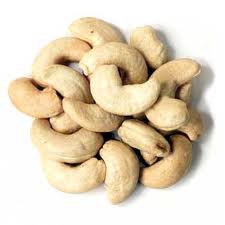
Cashew nut measures about a inch in length and 1/2 inches in diameter with kidney or bean shape, and smooth curvy pointed tip. Each nut has two equal halves as in legumes. The nuts are cream white color with firm yet delicate texture and smooth surface. Cashews have buttery texture with pleasant sweet fruity aroma.It has delicate flavor and a slightly spongy, firm texture. These seeds are related to pistachio nuts and mangoes.


LinkWithin

Related Posts Plugin for WordPress, Blogger...